
Image Source: finimpactcom.s3.eu-west-2.amazonaws.com
How Much Does It Cost To Start Up A Gym: Realistic Costs
Starting a gym can be a rewarding venture, but figuring out the initial investment is crucial. The cost to start a gym varies significantly, but a reasonable estimate for a small to medium-sized facility could range from $50,000 to $300,000 or more, depending heavily on location, size, and the type of fitness offerings. This wide range reflects the many different gym startup costs and gym business expenses involved.
Deciphering The Opening A Gym Price Tag
When you consider opening a gym price, it’s not just about the equipment. There are many layers to this financial cake. From securing a prime location to ensuring you have the right permits, every step has a cost. Let’s break down the major components that contribute to the overall gym startup costs.
The Foundation: Location and Leasehold Improvements
The physical space is the bedrock of your gym. Finding the right location is paramount. Factors like visibility, accessibility, parking, and the demographic of the surrounding area all play a role.
Site Selection and Lease Negotiations
- Rent/Purchase Price: This is often the largest recurring cost. Depending on your city and neighborhood, rent can vary wildly. A small studio space in a less affluent area might be $1,000-$3,000 per month, while a larger commercial space in a prime urban location could easily be $10,000-$30,000 or more. If you decide to purchase, the upfront cost will be substantial, requiring a mortgage and property taxes.
- Security Deposit: Typically, landlords require one to three months’ rent upfront as a security deposit. This could be anywhere from $3,000 to $90,000 or more for a premium location.
- Leasehold Improvements: This is where your vision starts to take shape, but it’s also a significant expense. Gym leasehold improvements refer to any modifications made to the rented space to suit your gym’s needs. This can include:
- Flooring: Durable, shock-absorbent flooring for weight areas, impact-resistant flooring for cardio zones, and perhaps specialized flooring for studios. Costs can range from $5 to $25 per square foot. For a 3,000 sq ft gym, this could be $15,000 to $75,000.
- Demolition and Construction: If you’re renovating an existing space, you might need to knock down walls, build new ones, or reconfigure the layout. This is highly variable but can easily add $20,000 to $100,000+.
- Painting and Decor: A fresh coat of paint, inspiring murals, and branding elements. This is relatively minor, perhaps $1,000 to $5,000.
- Lighting: Proper lighting is crucial for atmosphere and safety. This can include ambient lighting, task lighting, and accent lighting. Expect to spend $2,000 to $10,000.
- Restrooms and Changing Areas: Upgrading or installing new restrooms, showers, and changing rooms. This is a substantial cost, potentially $10,000 to $50,000 depending on the scale.
- HVAC System: Ensuring adequate ventilation and climate control is vital for comfort. You might need to upgrade or install a new system, costing $5,000 to $20,000.
- Sound System: Good sound quality enhances the workout experience. Installation and equipment can cost $1,000 to $5,000.
- Mirrors: Essential for form correction, mirrors are a must. Budget $5 to $15 per square foot for mirrored walls. For a 3,000 sq ft gym, this could be $15,000 to $45,000.
Estimated Costs for Leasehold Improvements (Example for a 3,000 sq ft space):
| Improvement Type | Estimated Cost Range |
|---|---|
| Flooring | $15,000 – $75,000 |
| Demolition/Construction | $20,000 – $100,000+ |
| Painting/Decor | $1,000 – $5,000 |
| Lighting | $2,000 – $10,000 |
| Restrooms/Changing Areas | $10,000 – $50,000 |
| HVAC System | $5,000 – $20,000 |
| Sound System | $1,000 – $5,000 |
| Mirrors | $15,000 – $45,000 |
| Total Estimated Range | $69,000 – $310,000+ |
Gearing Up: Gym Equipment Costs
This is often the most significant portion of gym startup costs. The type and quality of equipment you choose will heavily influence the price. Are you aiming for a high-end boutique studio or a budget-friendly community gym?
Cardio Equipment
- Treadmills: $1,500 – $5,000+ each
- Ellipticals/Cross-Trainers: $1,000 – $4,000+ each
- Stationary Bikes (Upright, Recumbent, Spin): $500 – $3,000+ each
- Rowing Machines: $800 – $2,500+ each
- Stair Climbers: $3,000 – $8,000+ each
Strength Training Equipment
- Weight Machines (Selectorized): $2,000 – $7,000+ per machine. A full set of 10-15 machines could be $20,000 – $105,000.
- Free Weights (Dumbbells, Barbells, Kettlebells): A comprehensive set of dumbbells (e.g., 5 lbs to 100 lbs pairs) can cost $3,000 – $10,000+. Barbells and weight plates add another $2,000 – $5,000+.
- Racks and Cages (Squat Racks, Power Cages): $500 – $3,000+ each. If you plan for a functional training area with multiple racks, this can be substantial.
- Weight Benches: $200 – $1,000+ each.
Functional Training and Other Equipment
- Resistance Bands, Medicine Balls, Stability Balls: Relatively inexpensive, $500 – $2,000 for a good selection.
- Plyometric Boxes, Battle Ropes, TRX Suspension Trainers: $1,000 – $5,000 for a variety.
- Cardio Accessories (Mats, Jump Ropes): $200 – $1,000.
Considerations for Gym Equipment Costs
- New vs. Used: Buying used equipment can significantly reduce costs, but ensure it’s in good working condition and from a reputable seller.
- Brand and Quality: High-end brands often come with higher price tags but may offer better durability and warranty.
- Quantity: The number of each item you need depends on your expected member volume and the size of your facility.
A well-equipped, medium-sized gym might need $30,000 to $150,000 or more in gym equipment costs.
The Legal Framework: Licensing and Permits
Before you can even open your doors, you’ll need to navigate the legalities. Gym licensing fees and permits are essential to operate legally.
- Business License: Every business needs this. Costs vary by municipality, typically $50 – $500 annually.
- Health and Safety Permits: Depending on your location, you might need inspections and permits related to sanitation, fire safety, and public access. These can range from $100 to $1,000+.
- Zoning Permits: Ensuring your location is zoned for a fitness facility. This might involve a one-time fee of $100 – $500.
- Professional Certifications: While not strictly a permit, ensuring your instructors have proper certifications (e.g., CPR, First Aid, specific fitness specializations) is crucial. This is more of an ongoing operational cost but vital for startup.
- Music Licensing: If you play music in your gym, you’ll need licenses from organizations like ASCAP, BMI, and SESAC. This can be a few hundred to over a thousand dollars annually, depending on your size and music usage.
Gym licensing fees can add up to a few hundred to a couple of thousand dollars initially, plus annual renewals.
Creating the Vibe: Interior Design and Branding
The look and feel of your gym are crucial for attracting and retaining members.
- Signage: Exterior and interior signs are vital for branding and visibility. This could range from $500 to $5,000+.
- Reception Desk and Waiting Area: Comfortable seating, a professional desk, and potential branding elements. $2,000 – $10,000.
- Locker Room Furnishings: Lockers, benches, mirrors, and toiletries. $3,000 – $15,000.
- Water Fountains/Filtration Systems: $500 – $3,000.
- Cleaning Supplies and Equipment: Initial stock and professional cleaning equipment. $500 – $2,000.
- IT Infrastructure: Computers, POS system, Wi-Fi, security cameras. $2,000 – $8,000.
Fueling the Engine: Initial Marketing and Sales Budget
To get people through the door, you need a solid marketing strategy.
- Website Development: A professional website is essential. $1,000 – $5,000+.
- Branding and Logo Design: Creating a strong brand identity. $500 – $3,000.
- Pre-Opening Marketing: Social media campaigns, local advertising, flyers, grand opening events. $2,000 – $10,000.
- Membership Management Software: Essential for tracking members, payments, and scheduling. $50 – $500 per month, so factor in a few months upfront.
A realistic gym marketing budget for the initial launch could be anywhere from $5,000 to $20,000.
Building Your Team: Gym Staffing Costs
Your staff are the face of your gym. Hiring and retaining quality personnel is key.
- Salaries/Wages: This is an ongoing gym operational cost, but you’ll need to factor in initial payroll, including a reserve for the first few months before revenue stabilizes.
- Gym Manager: $35,000 – $60,000 annually.
- Personal Trainers: Often work on commission or per session, but you might need to pay a base for some.
- Front Desk Staff: $10 – $18 per hour.
- Group Fitness Instructors: Typically paid per class.
- Payroll Taxes and Benefits: Add 15-30% on top of base salaries.
- Training and Onboarding: Ensuring your staff are well-trained and knowledgeable. $500 – $2,000 for initial training.
Initial gym staffing costs will include recruitment, hiring, and potentially advance payments or training for your core team.
The Safety Net: Insurance
Protecting your business is crucial.
- General Liability Insurance: Covers accidents and injuries on your premises.
- Professional Liability Insurance (Errors & Omissions): Protects against claims of negligence by trainers.
- Property Insurance: Covers your building and equipment.
- Workers’ Compensation Insurance: If you have employees.
Insurance premiums vary widely but budget for $1,000 – $5,000 annually, with some upfront payment likely.
The Rainy Day Fund: Working Capital
You won’t be profitable on day one. You need cash to cover gym operational costs until your membership base is stable.
- Rent and Utilities: For the first 3-6 months.
- Payroll: For the first 3-6 months.
- Marketing: Ongoing campaigns.
- Inventory: Supplements, merchandise, etc.
- Unexpected Expenses: Always have a buffer.
A good rule of thumb is to have 6-12 months of operating expenses in reserve. This could be $30,000 to $100,000+.
Putting It All Together: Estimated Total Startup Costs
Let’s look at a hypothetical breakdown for a small to medium-sized gym (approx. 3,000-5,000 sq ft) to illustrate the potential gym startup costs. This is a broad estimate, and your actual costs will vary.
| Cost Category | Estimated Low End | Estimated High End |
|---|---|---|
| Leasehold Improvements | $69,000 | $310,000+ |
| Gym Equipment Costs | $30,000 | $150,000+ |
| Licensing & Permits | $500 | $2,000 |
| Interior Design/Branding | $3,500 | $23,000 |
| Initial Marketing | $5,000 | $20,000 |
| Initial Staffing Costs | $5,000 | $15,000 |
| Insurance (Initial) | $1,000 | $5,000 |
| Working Capital Reserve | $30,000 | $100,000+ |
| Contingency (10-15%) | $14,400 | $72,500+ |
| Total Estimated Range | $158,400 | $697,500+ |
As you can see, the range is substantial. A small, specialized studio focusing on a niche like yoga or CrossFit might be on the lower end, while a full-service gym with a pool and extensive equipment will be on the higher end.
Gym Financing Options: How to Fund Your Dream
Securing funding is a critical step. Fortunately, there are several gym financing options available.
1. Personal Savings and Loans
- Pros: Most accessible, no interest to pay to third parties.
- Cons: High personal risk, can deplete your savings.
2. Small Business Administration (SBA) Loans
- Pros: Government-backed, often offer competitive interest rates and longer repayment terms.
- Cons: Rigorous application process, can take time to get approved.
3. Bank Loans
- Pros: Traditional method, can offer substantial amounts.
- Cons: Requires a strong business plan and credit history, collateral may be needed.
4. Crowdfunding
- Pros: Can generate buzz and a customer base before opening, allows you to gauge interest.
- Cons: Requires a compelling pitch, success is not guaranteed, might involve giving away equity or rewards.
5. Investors (Angel Investors or Venture Capitalists)
- Pros: Can provide significant capital and valuable expertise.
- Cons: You will give up a portion of ownership and control of your business.
6. Equipment Financing
- Pros: Allows you to acquire expensive equipment without a large upfront capital outlay, payments are spread over time.
- Cons: You don’t own the equipment until it’s paid off, interest adds to the overall cost.
Frequently Asked Questions (FAQ)
- Q: What is the minimum cost to start a gym?
- A: A very basic, small, specialized fitness studio (like a single-room yoga studio or a small CrossFit box with minimal equipment) could potentially be started for as little as $30,000-$50,000, but this would involve significant compromises on equipment, location, and amenities.
- Q: Can I start a gym with no money?
- A: It’s highly unlikely to start a physical gym location with absolutely no money. You’ll need funds for permits, basic setup, and potentially some initial equipment or lease deposits. However, you could start a fitness business online or as a mobile personal training service with very little capital.
- Q: What are the biggest expenses when opening a gym?
- A: Typically, the biggest expenses are gym equipment costs and gym leasehold improvements. Rent and working capital are also significant ongoing and upfront costs.
- Q: How much does gym equipment cost on average?
- A: For a medium-sized gym, expect gym equipment costs to range from $30,000 to $150,000+. This depends heavily on the quantity and quality of machines and free weights you purchase.
- Q: What are ongoing gym operational costs?
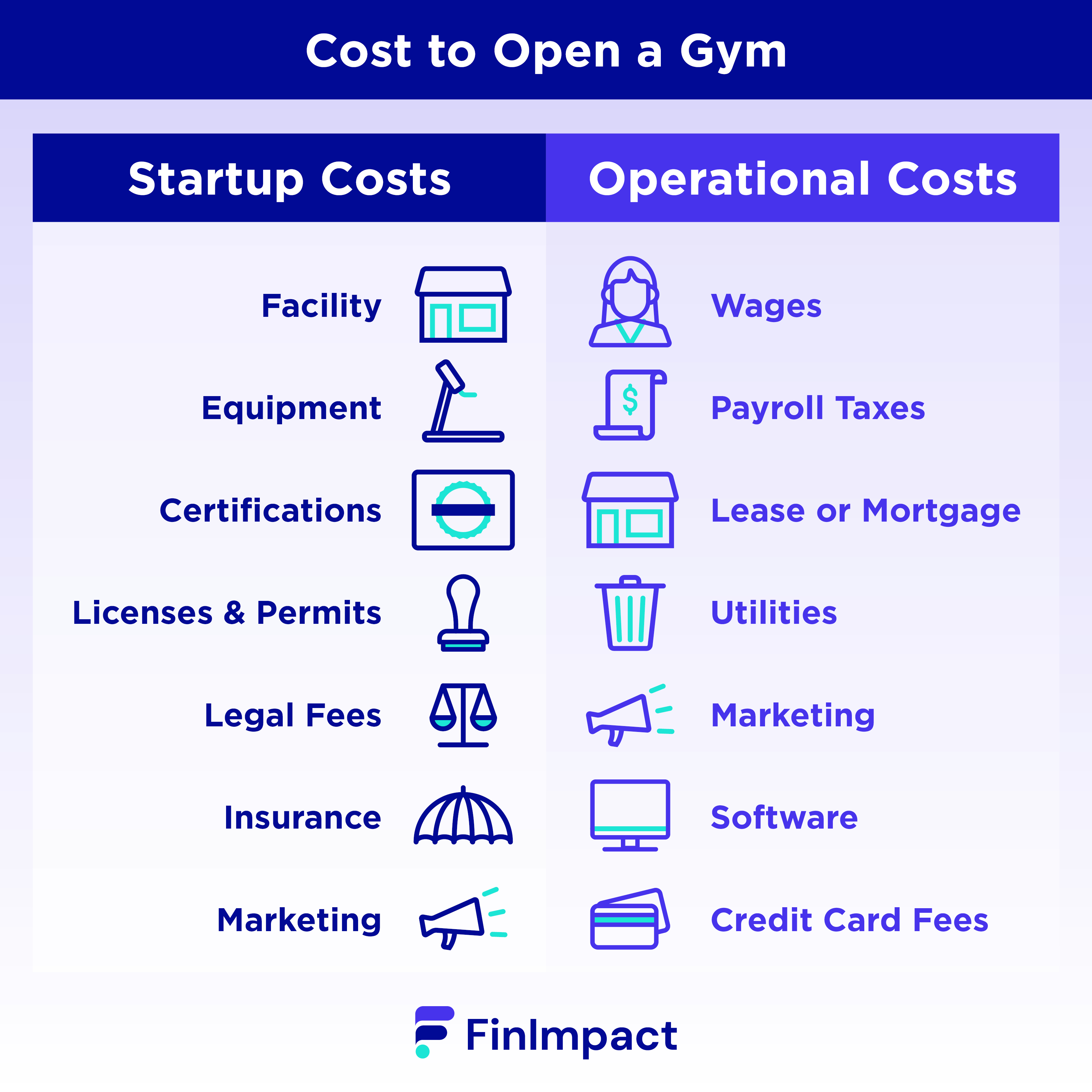
- A: Ongoing gym operational costs include rent, utilities (electricity, water, internet), salaries and wages, marketing, insurance, equipment maintenance, cleaning supplies, software subscriptions, and potentially loan repayments.
Launching a gym is a significant financial undertaking. Thorough research, a robust business plan, and securing appropriate gym financing options are essential for turning your fitness vision into a profitable reality. By carefully considering all the gym startup costs and planning for ongoing gym operational costs, you can set your gym up for long-term success.