
A knee sprain can make you wonder when you will feel normal again. You can often begin gentle movement a few days after a knee sprain. But returning to full exercise, like running, can take weeks to many months. It depends on how bad your sprain is. Every person’s knee sprain recovery timeline is different. For example, you might be able to start light jogging after 6-12 weeks for a mild sprain. But a bad sprain can take 6 months or more to get back to running. This guide will help you know what to expect.
Image Source: my.clevelandclinic.org
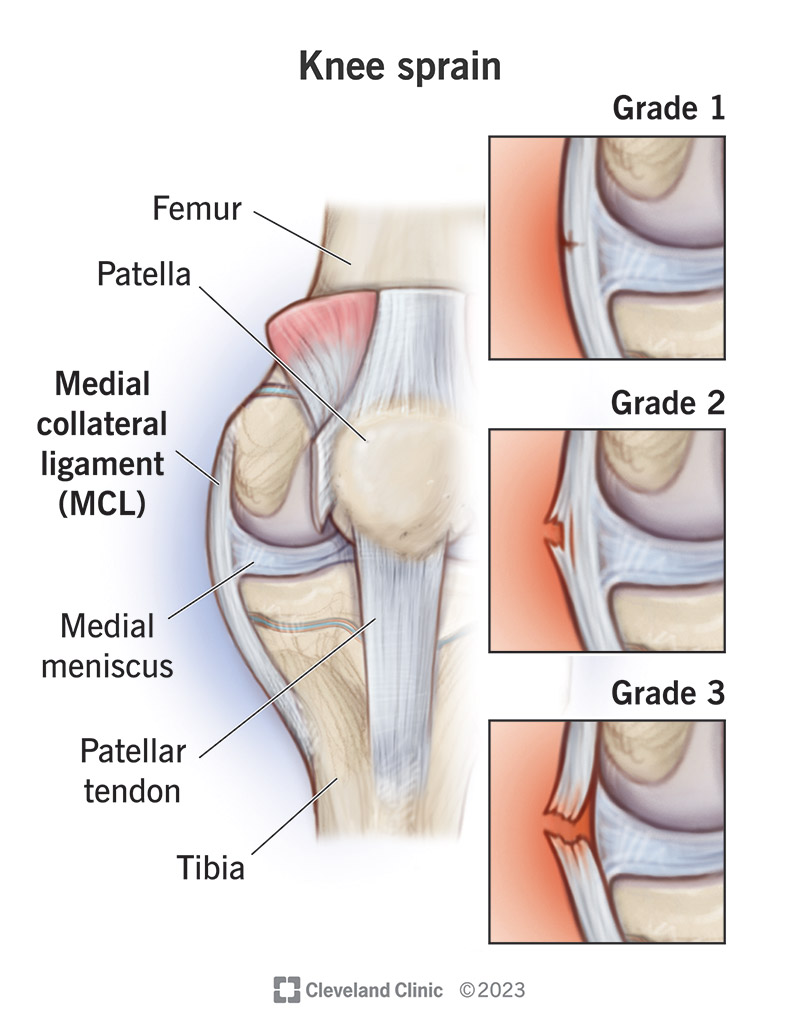
What is a Knee Sprain?
A knee sprain happens when you stretch or tear the strong bands of tissue called ligaments. These ligaments connect your bones. They hold your knee joint together. They keep your knee stable. When you twist your knee, fall, or get a direct hit, a sprain can happen.
Types of Knee Ligaments
Your knee has four main ligaments. They help your knee move the right way. They stop it from moving too far.
- Anterior Cruciate Ligament (ACL): This ligament is in the front of your knee. It stops your shin bone from sliding too far forward. It helps control how your knee turns.
- Posterior Cruciate Ligament (PCL): This ligament is in the back of your knee. It stops your shin bone from sliding too far backward.
- Medial Collateral Ligament (MCL): This ligament is on the inside of your knee. It stops your knee from bending inward too much.
- Lateral Collateral Ligament (LCL): This ligament is on the outside of your knee. It stops your knee from bending outward too much.
The MCL is the most common ligament to sprain in the knee. The ACL is also often injured, especially in sports.
Grasping Your Knee Sprain Grade
Doctors grade knee sprains based on how bad the damage is. This grade helps predict your knee sprain healing time. It also guides your return to exercise after knee injury.
- Grade 1 Sprain (Mild): The ligament is stretched. It has tiny tears. Your knee might be a bit tender or swollen. It feels stable.
- Grade 2 Sprain (Moderate): The ligament is partly torn. You will have more pain, swelling, and bruising. Your knee might feel loose or give out sometimes.
- Grade 3 Sprain (Severe): The ligament is fully torn. Your knee will be very painful, swollen, and unstable. You might hear a pop sound when it happens. This grade often needs surgery.
Initial Steps After a Knee Sprain
Right after you sprain your knee, act fast. This can help reduce pain and swelling. It can speed up your recovery. Follow the RICE method:
- Rest: Stop any activity that hurts your knee. Give your knee time to heal. Use crutches if walking is painful.
- Ice: Put ice on your knee for 15-20 minutes every 2-3 hours. Do this for the first few days. It helps with swelling and pain.
- Compression: Wrap your knee with an elastic bandage. Do not wrap it too tightly. This also helps reduce swelling.
- Elevation: Keep your knee above your heart level. Prop it up on pillows when you rest. This also helps with swelling.
You should see a doctor soon after a knee sprain. They can check your knee. They can tell you the grade of your sprain. They can suggest the best plan for you.
Your Recovery Timeline: Phase by Phase
The knee sprain recovery timeline is not set in stone. It changes based on your sprain’s grade. It also depends on your age, overall health, and how well you follow your recovery plan. But we can give you a general guide.
Phase 1: Acute Pain and Protection (Days 0-7)
This phase focuses on protecting your knee. You want to control pain and swelling.
- Goal: Reduce pain and swelling. Protect the injured ligament.
- Activity: Use crutches to avoid weight on your knee if it hurts. Rest often. Keep your knee elevated. Apply ice regularly.
- Gentle Movement: Your doctor might suggest small, gentle movements. These keep your knee from getting stiff. Do not push through pain. This is not the time for hard rehabilitation exercises for knee sprain.
Phase 2: Early Healing and Gentle Movement (Week 1-3)
As pain and swelling go down, you can start gentle exercises. These movements help your knee get back its normal range.
- Goal: Get more knee movement. Start gentle muscle activation.
- Activity: You might slowly put more weight on your leg. You might use one crutch or stop using them completely.
- Exercises:
- Heel Slides: Lie on your back. Slowly slide your heel towards your buttock. Keep your heel on the bed. Go as far as you can without pain. Then slide it back.
- Quad Sets: Lie on your back. Straighten your leg. Push the back of your knee down into the bed. You should feel your thigh muscle tighten. Hold for 5 seconds.
- Hamstring Curls (Gentle): Lie on your stomach. Slowly bend your knee. Bring your heel towards your buttock. Do not lift your thigh off the bed.
- Ankle Pumps: Move your foot up and down. This helps reduce swelling in your leg.
Physical therapy for knee sprain often starts in this phase. A therapist will guide you. They make sure you do exercises safely.
Phase 3: Strengthening and Balance (Week 3-6+)
Once your pain is low and you have good knee movement, you can start strengthening. This phase builds up the muscles around your knee. Strong muscles help support the joint.
- Goal: Build strength in leg muscles. Improve balance and stability.
- Activity: You should be able to walk without crutches. You can do light daily tasks.
-
Strengthening Exercises Post Knee Sprain:
- Straight Leg Raises: Lie on your back. Keep your injured leg straight. Lift it slowly about 6-12 inches off the floor. Keep your thigh muscles tight. Lower slowly.
- Mini Squats: Stand with your feet shoulder-width apart. Slowly bend your knees as if you are sitting in a chair. Go only a little way down. Keep your back straight. Do not let your knees go past your toes.
- Wall Sits: Lean your back against a wall. Slide down until your knees are bent at about a 45-degree angle. Hold this pose.
- Calf Raises: Stand tall. Lift your heels off the ground. Go up onto the balls of your feet. Hold briefly. Lower slowly.
-
Stationary Bike (Low Resistance): Start with easy pedaling. This is a good way to get your knee moving without putting too much stress on it. It helps your heart and lungs too.
-
Safe Exercises After MCL Sprain: If you sprained your MCL, focus on side-to-side stability. These exercises are often good:
- Clamshells: Lie on your side. Bend your knees. Keep your feet together. Lift your top knee away from the bottom one, like a clamshell opening. This strengthens hip muscles that support your knee.
- Side Leg Raises: Lie on your side. Keep your legs straight. Lift your top leg up towards the ceiling. Keep your foot pointing forward.
-
Balance Exercises:
- Single Leg Stand: Stand on your injured leg. Hold onto something for balance at first. Try to balance without holding on.
- Bosu Ball or Balance Board: If you have one, standing on these can greatly improve knee stability. Start with two feet, then try one.
Table of Recommended Exercises by Phase
| Phase | Goal | Example Exercises | Equipment Needed |
|---|---|---|---|
| Phase 1: Acute | Reduce pain/swelling, protect knee | Gentle heel slides (if pain allows), ankle pumps. Mostly rest. | None |
| Phase 2: Early | Improve movement, start muscle use | Heel slides, Quad sets, Gentle hamstring curls, Straight Leg Raises (if pain allows), Stationary bike (low resistance). | None, stationary bike |
| Phase 3: Building | Increase strength, balance, stability | Mini squats, Wall sits, Calf raises, Clamshells, Side leg raises, Single leg stand, Light resistance bike. | Resistance bands, small weights (optional), balance board (optional), stationary bike |
Phase 4: Gradual Return to Activity (Week 6-12+)
This is where you prepare for more demanding activities. You slowly add back sports or running. This phase needs great care. You do not want to re-injure your knee.
- Goal: Full strength, agility, and power. Safe gradual return to activity knee sprain.
- Activity: You should feel strong and stable. You can do most daily tasks without pain.
- Exercises for Return to Sport:
- Fuller Squats and Lunges: Slowly increase the depth and number of reps. Add light weights if your therapist says it is okay.
- Plyometrics (Jumping Drills): Start with small jumps, like two-footed jumps. Then move to single-leg hops. Build up to box jumps or hurdle hops. Only do these if your knee feels strong.
- Agility Drills: Begin with simple cones drills. Work on changing direction. Do figure-eights or shuttle runs.
- Sport-Specific Drills: If you play a sport, practice movements from that sport. Start slow. For example, a basketball player might practice shooting free throws. Then move to light dribbling.
When Can I Run After Knee Sprain?
This is a big question for many people. When can I run after knee sprain? It depends on the sprain grade.
- Grade 1 Sprain: You might start a light jog after 2-4 weeks. Your doctor or physical therapist will guide you.
- Grade 2 Sprain: It might be 6-12 weeks before you can start light jogging. You need to be pain-free. Your knee needs to feel stable.
- Grade 3 Sprain: This can take 6 months to a year or more. If you had surgery, it will take even longer. Running will only happen after extensive physical therapy for knee sprain. Your knee must have full strength and stability.
Guidelines for Return to Running
- No Pain: You should have no pain when walking fast.
- Full Strength: Your injured leg should be as strong as your uninjured leg.
- Good Balance: You should be able to stand on one leg for a long time. You should feel steady.
- Start Slow: Begin with walking for a few minutes. Then add very short jogs. For example, run for 1 minute, walk for 4 minutes. Do this for 20-30 minutes.
- Increase Slowly: Do not increase your running distance or time by more than 10-15% each week.
- Listen to Your Body: If you feel pain, stop. Rest. Go back to an easier level of exercise.
The Value of Physical Therapy for Knee Sprain
Physical therapy for knee sprain is very important. A good physical therapist (PT) is like a coach for your knee. They create a special exercise plan for you. They make sure you do exercises correctly. They can see problems you might miss.
A PT helps with:
- Pain Relief: They use methods like ice, heat, or special machines to help reduce pain.
- Movement: They help you get back full range of motion in your knee.
- Strength: They give you exercises to build strong muscles around your knee.
- Balance: They help your knee learn to balance and react quickly.
- Progression: They tell you when it is safe to do harder exercises. They guide your gradual return to activity knee sprain.
- Education: They teach you how to move your body to avoid future injuries. They show you how to do rehabilitation exercises for knee sprain at home.
For any sprain worse than Grade 1, working with a PT is highly recommended. For a Grade 3 sprain, it is almost always needed.
Ensuring No Re-Injury: Preventing Re-Injury Knee Sprain
The worst thing is to injure your knee again. Preventing re-injury knee sprain needs careful thought. It is not just about healing. It is about making your knee stronger and smarter.
Key Strategies for Preventing Re-Injury
- Do Not Rush Recovery: This is the most important rule. Listen to your body. Do not try to do too much too soon. Follow your physical therapist’s advice.
- Continue Strengthening: Even after you feel better, keep doing your strengthening exercises post knee sprain. Make them part of your routine. Focus on your hamstrings, quadriceps, glutes, and core.
- Warm Up Properly: Before any exercise or sport, warm up your muscles. Do light cardio like jogging. Then do dynamic stretches. These are movements that get your body ready.
- Cool Down: After exercise, do static stretches. Hold each stretch for 20-30 seconds. This helps your muscles stay flexible.
- Use Good Technique: When you run, jump, or play sports, use correct form. Bad form puts extra stress on your knee. A coach or PT can help you check your form.
- Wear Proper Footwear: Wear shoes that fit well. Make sure they give good support. Replace old or worn-out shoes.
- Consider Bracing (If Advised): For some types of knee sprains, your doctor might suggest a brace. It can give extra support during certain activities.
- Cross-Train: Do other activities that do not stress your knee as much. Swimming, cycling, or elliptical training keep you fit. They let your knee rest from high-impact sports.
- Listen to Your Body’s Warning Signs: If you feel pain, stop. Do not push through it. Pain is your body telling you something is wrong.
- Maintain Overall Fitness: A strong, healthy body handles stress better. Eat well. Get enough sleep. Stay hydrated.
How Long Does a Knee Sprain Take to Heal?
The knee sprain healing time varies a lot.
- Grade 1 Sprain: Usually 2-4 weeks. Some people feel better faster.
- Grade 2 Sprain: Can take 6-12 weeks. Some might take longer.
- Grade 3 Sprain: This can take 6 months to a year or even more. If surgery is needed, the recovery time is longer.
Remember, healing is not just about pain going away. It is about the ligament tissue fully repairing. It is about your muscles getting strong again. It is about your knee getting its full movement and stability back.
Summary: Your Path to a Stronger Knee
Getting over a knee sprain takes patience and hard work. Your knee sprain recovery timeline will be unique. But by following these steps, you can get back to your activities safely.
- Start with RICE right away.
- Get checked by a doctor.
- Follow your physical therapist’s plan.
- Do your rehabilitation exercises for knee sprain every day.
- Make sure your return to exercise after knee injury is slow and steady.
- Focus on strengthening exercises post knee sprain.
- Learn about safe exercises after MCL sprain if that is your injury.
- Do not rush when can I run after knee sprain. Wait until your knee is truly ready.
- Embrace a gradual return to activity knee sprain.
- Always work on preventing re-injury knee sprain.
Your knee will thank you for taking the time to heal it right.
Frequently Asked Questions (FAQ)
Q: Can I walk on a sprained knee right after it happens?
A: For mild sprains (Grade 1), you might be able to walk a little. But it is best to rest it. For worse sprains, you will likely need crutches. Walking too much can make the injury worse. Always listen to your body and your doctor.
Q: What is the biggest mistake people make during knee sprain recovery?
A: The biggest mistake is doing too much, too soon. People often rush back to sports or hard exercise before their knee is ready. This greatly increases the chance of re-injury. Patience is key.
Q: Do I need surgery for a knee sprain?
A: Most Grade 1 and Grade 2 knee sprains do not need surgery. They heal with rest and physical therapy. Grade 3 sprains, especially an ACL tear, often need surgery. Your doctor will tell you if surgery is needed.
Q: How do I know if my knee is ready for more intense exercise?
A: Your knee should have no pain with daily activities. It should have full movement. It should feel strong and stable. You should be able to do balance drills easily. Your physical therapist will do tests to see if you are ready.
Q: Are there any foods that help my knee heal faster?
A: Eating a healthy diet helps your body heal. Focus on foods rich in protein for tissue repair. Get vitamins and minerals like Vitamin C and Zinc. These help with collagen building and reducing swelling. Eating anti-inflammatory foods like fruits, vegetables, and omega-3s can also help.
Q: What if my knee pain comes back during exercise?
A: If you feel pain, stop the exercise. Rest your knee. Apply ice. It means you might have pushed too hard. Go back to easier exercises. If the pain continues, talk to your doctor or physical therapist.