
What is a tabletop exercise? A tabletop exercise is a discussion-based session where key personnel talk through their roles and responsibilities during a simulated incident. Can I use a tabletop exercise for any type of emergency? Yes, tabletop exercises are versatile and can be adapted for various scenarios, from natural disasters to cyberattacks. Who is typically involved? It includes individuals who would play a crucial role in responding to the simulated event, such as department heads, emergency coordinators, and key operational staff.
Conducting a tabletop exercise is a cornerstone of effective crisis management and robust emergency response plan development. It’s a practical way to test and refine your organization’s preparedness without the complexities and costs of a full-scale drill. By bringing together key personnel in a relaxed, discussion-based format, you can identify gaps in communication, policy, and procedures before a real crisis strikes. This deep dive into scenario planning allows teams to walk through a hypothetical event, assess their responses, and pinpoint areas for improvement. This article will guide you through the best practices for successfully conducting a tabletop exercise, from initial exercise design to the crucial debriefing and after action report.
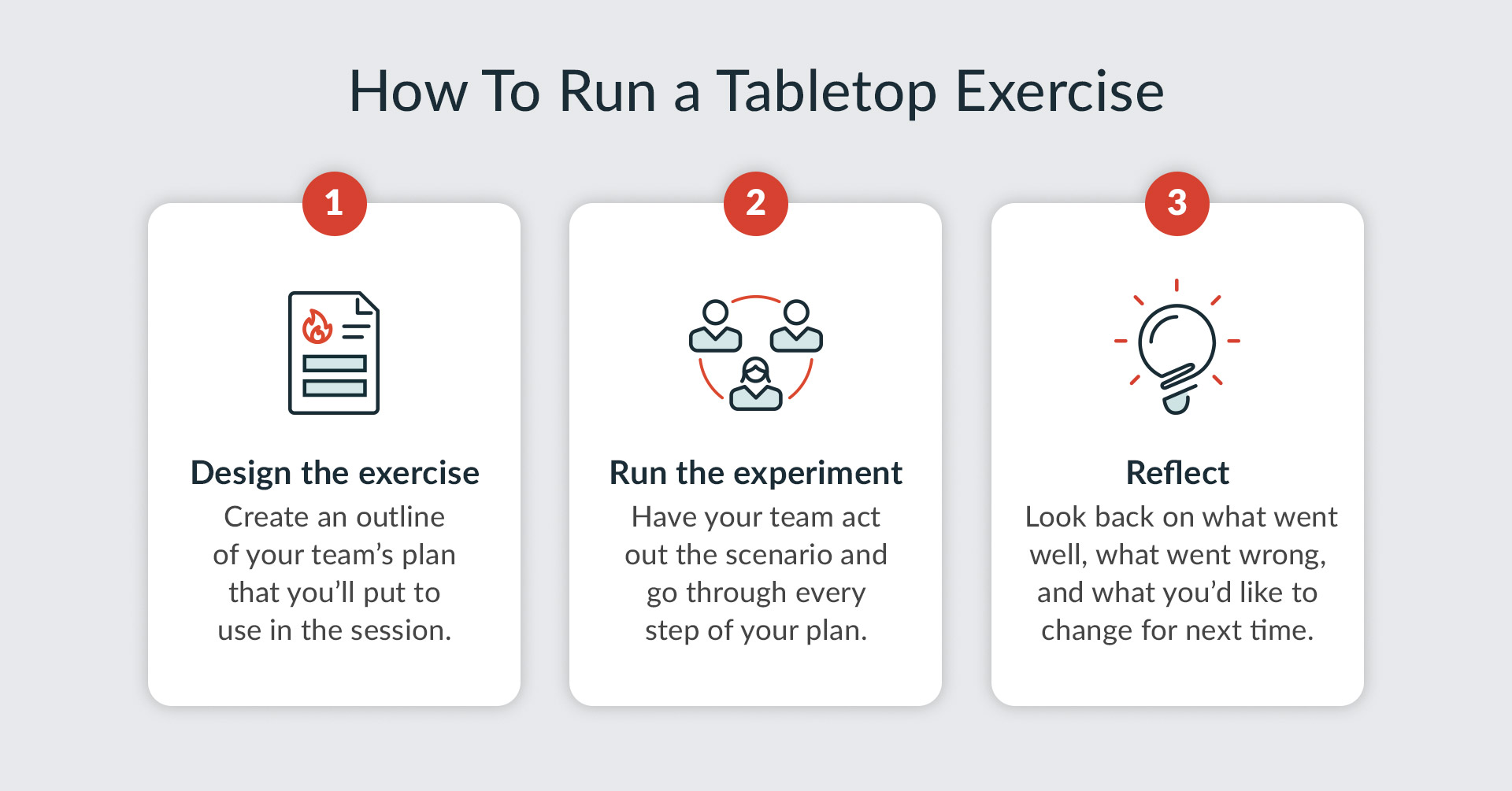
Image Source: www.alertmedia.com
The Purpose of Tabletop Exercises
Tabletop exercises are more than just meetings; they are strategic tools for enhancing organizational resilience. They provide a safe space to:
- Validate Plans: Test the effectiveness and practicality of existing emergency response plans and contingency planning.
- Improve Communication: Identify communication breakdowns and establish clear lines of communication between departments and external agencies.
- Enhance Coordination: Foster collaboration and clarify roles and responsibilities among participants.
- Identify Gaps: Uncover weaknesses in policies, procedures, resources, and training.
- Build Confidence: Increase participant familiarity with their roles and the overall response process.
- Familiarize Staff: Introduce new team members to the organization’s crisis management protocols.
Step 1: Defining Your Objectives and Scope
Before diving into exercise design, clearly defining what you want to achieve is paramount. What specific aspects of your preparedness are you looking to test?
Setting Clear Objectives
Objectives should be SMART: Specific, Measurable, Achievable, Relevant, and Time-bound. Examples include:
- To validate the effectiveness of the communication plan during a cyberattack.
- To assess the decision-making process of the incident management team during a natural disaster.
- To confirm that all personnel know their roles and responsibilities within the first hour of a building evacuation.
Determining the Scope
The scope defines the boundaries of your exercise. Consider:
- Type of Incident: What kind of event will you simulate? (e.g., power outage, data breach, active shooter, pandemic).
- Participants: Who needs to be involved? (e.g., IT, HR, Security, Operations, Legal, Communications).
- Timeframe: How long will the exercise last? (Typically 2-4 hours).
- Location: Where will the exercise be held? (A conference room is common for tabletop simulation).
Step 2: Crafting Your Scenario and Inject Strategy
A well-crafted scenario is the heart of a successful tabletop exercise. It needs to be realistic and challenging enough to elicit meaningful discussion.
Developing the Scenario
Your scenario planning should start with a believable event. Think about:
- Likelihood: How probable is this event for your organization?
- Impact: What would the consequences be?
- Complexity: Does it require coordination across multiple departments?
Table 1: Scenario Examples
| Incident Type | Brief Scenario Description | Key Focus Areas |
|---|---|---|
| Cybersecurity Breach | A ransomware attack encrypts critical company data, demanding a significant payment. | IT response, data recovery, legal implications, communication |
| Natural Disaster | A severe earthquake disrupts power and communications, damaging a key facility. | Evacuation, facility damage assessment, business continuity |
| Workplace Violence | An unauthorized individual gains access to the building and exhibits threatening behavior. | Security response, employee safety, communication with law enforcement |
| Supply Chain Disruption | A major supplier experiences a catastrophic failure, halting production of a critical component. | Procurement, alternative sourcing, production impact, customer communication |
Designing Effective Injects
Injects are planned events or pieces of information introduced during the exercise to move the scenario forward and test specific responses. They should be timed to challenge participants at critical junctures.
-
Types of Injects:
- Information Updates: New details about the incident (e.g., “The FBI is now involved”).
- Resource Issues: Limited availability of critical resources (e.g., “The emergency generator is malfunctioning”).
- Policy Questions: Situations that require interpretation of policies (e.g., “Do we have a policy for communicating with the media during a data breach?”).
- External Factors: Interventions from other agencies or stakeholders (e.g., “The local fire department has declared the building unsafe”).
-
Inject Best Practices:
- Clarity: Injects must be clear and unambiguous.
- Timing: Introduce them strategically to create challenges.
- Relevance: Ensure they directly relate to the scenario and objectives.
- Pacing: Don’t overwhelm participants with too many injects at once.
Step 3: Developing the Facilitator Guide
The facilitator guide is your roadmap for conducting the tabletop simulation. It provides structure, ensures consistency, and helps the facilitator manage the discussion effectively.
Key Components of a Facilitator Guide
- Introduction and Welcome: Clearly state the purpose and objectives of the exercise.
- Scenario Briefing: Present the initial scenario and any background information.
- Ground Rules: Establish expectations for participation (e.g., “Assume roles,” “No criticism,” “Think aloud”).
- Timeline: Outline the planned progression of the exercise, including when injects will be introduced.
- Discussion Questions: Prepare open-ended questions for each phase of the scenario to prompt critical thinking and discussion.
- Inject Descriptions: Detail each inject, its timing, and how it will be delivered.
- Participant Roles: Briefly outline the key roles and responsibilities of the participants.
- Contingency Plans: Include notes on how to handle unexpected tangents or issues.
- Debriefing Prompts: Prepare questions for the post-exercise debriefing.
The Facilitator’s Role
The facilitator is crucial for a productive tabletop simulation. Their responsibilities include:
- Guiding the Discussion: Keeping participants focused on the scenario and objectives.
- Managing Time: Adhering to the planned schedule.
- Asking Probing Questions: Encouraging deeper thinking and analysis.
- Ensuring All Voices are Heard: Creating an inclusive environment.
- Remaining Neutral: Avoiding taking sides or injecting personal opinions.
- Recording Key Decisions and Observations: Documenting the discussion.
Step 4: Preparing Participants and the Environment
Effective preparation sets the stage for success.
Participant Selection and Briefing
- Select the Right People: Choose individuals who would be directly involved in the response.
- Pre-Exercise Briefing: Provide participants with the scenario overview, objectives, and their expected roles in advance. This allows them to familiarize themselves with the context.
- Roles: Assign specific roles to participants (e.g., Incident Commander, Public Information Officer, Operations Chief) even if they don’t hold those titles in their daily jobs. This helps them think from a specific functional perspective.
Setting Up the Exercise Environment
- Location: Choose a comfortable, quiet space with adequate seating and tables. A conference room is ideal for a tabletop simulation.
- Materials: Have copies of the scenario, objectives, facilitator guide, and notepads and pens readily available.
- Visual Aids: Consider using a projector or whiteboard to display the timeline, key decisions, or organizational charts.
- Refreshments: Provide water and snacks to keep participants engaged.
Step 5: Conducting the Tabletop Exercise
This is where the planning comes to fruition.
Exercise Flow
- Opening: The facilitator welcomes participants, reiterates the purpose, objectives, and ground rules.
- Scenario Introduction: The initial scenario is presented.
- Discussion and Action: Participants discuss how they would respond to the initial situation, assuming their assigned roles. The facilitator uses prepared questions to guide their thinking.
- Inject Delivery: As planned, the facilitator introduces injects. Participants discuss how these new developments impact their response and what actions they would take.
- Iteration: This process of discussion, injects, and action continues through the planned phases of the scenario.
- Climax and Resolution: The exercise progresses towards a simulated conclusion, allowing participants to discuss the final actions and outcomes.
- Wrap-up: The facilitator thanks participants and outlines the next steps, particularly the debriefing.
Facilitating Discussion Effectively
- Focus on “What would you do?”: Encourage participants to think about their actions and decisions, not just theoretical possibilities.
- Prompt for Rationale: Ask “why?” to understand the reasoning behind their proposed actions.
- Address Knowledge Gaps: If a participant is unsure about a procedure, note it for later review.
- Manage Dominant Personalities: Ensure everyone has a chance to speak.
- Capture Key Points: Have a designated note-taker or encourage participants to jot down important observations.
Step 6: The Crucial Debriefing Session
The debriefing is as important as the exercise itself. It’s where learning happens.
Objectives of the Debriefing
- Review Actions: Discuss the responses to the scenario and injects.
- Identify Strengths: Recognize what worked well and why.
- Identify Weaknesses: Pinpoint areas where the response was less effective.
- Discuss Lessons Learned: Articulate the key takeaways and actionable insights.
- Formulate Recommendations: Develop concrete steps for improvement.
Debriefing Best Practices
- Immediate Post-Exercise: Conduct the debriefing immediately after the exercise while the information is fresh.
- Structured Approach: Use a facilitator guide with pre-prepared questions.
- Open and Honest Dialogue: Create a safe environment for participants to share their thoughts without fear of reprisal.
- Focus on Systemic Issues: Look for patterns and underlying causes rather than blaming individuals.
- Document Thoroughly: Record all observations, discussions, strengths, weaknesses, and recommendations.
Table 2: Sample Debriefing Questions
| Category | Questions |
|---|---|
| Initial Response | How effective was the initial notification and assessment of the incident? What information was critical at this stage? |
| Communication | Were communication channels effective? What were the main challenges in sharing information? |
| Decision-Making | How were decisions made? Were there any roadblocks to timely and effective decision-making? |
| Resource Management | Were the necessary resources available? Were they utilized efficiently? |
| Coordination | How well did different departments or teams coordinate their efforts? What could improve inter-agency collaboration? |
| Plan Effectiveness | How well did the existing emergency response plan and contingency planning support the response? |
| Overall Performance | What were the biggest successes of the exercise? What were the most significant areas for improvement? |
| Future Actions | What specific actions should be taken to enhance preparedness based on this exercise? |
Step 7: Producing the After Action Report (AAR)
The after action report is the formal documentation of the exercise, its findings, and recommendations.
Key Elements of an After Action Report
- Executive Summary: A brief overview of the exercise, its objectives, key findings, and major recommendations.
- Exercise Overview: Details about the date, time, location, participants, scenario, and objectives.
- Strengths: A clear list of what worked well during the exercise.
- Areas for Improvement: A detailed description of the weaknesses and challenges identified.
- Recommendations: Specific, actionable recommendations to address the identified areas for improvement. Recommendations should be prioritized and assigned responsibility with target completion dates.
- Appendices: Include relevant supporting documents, such as participant lists, the scenario, and the facilitator guide.
Utilizing the After Action Report
The AAR is not an endpoint but a catalyst for improvement.
- Distribute Widely: Share the AAR with all participants and relevant stakeholders.
- Develop an Improvement Plan: Create a formal plan based on the recommendations, assigning ownership and timelines for implementation.
- Track Progress: Monitor the implementation of recommendations to ensure they are completed.
- Incorporate into Training: Use lessons learned to update training materials and future scenario planning.
- Revise Plans: Update your emergency response plan and contingency planning based on the identified gaps.
Best Practices Recap for Tabletop Exercise Success
To ensure your tabletop exercises are productive and lead to tangible improvements in preparedness, keep these best practices in mind:
- Clear Objectives: Define precisely what you aim to achieve.
- Realistic Scenarios: Develop plausible situations that challenge your organization.
- Targeted Injects: Use injects to drive the scenario and test specific responses.
- Detailed Facilitator Guide: Equip your facilitator with a comprehensive roadmap.
- Involve the Right People: Ensure participation from all relevant departments and roles.
- Active Facilitation: Guide the discussion to maximize learning.
- Thorough Debriefing: Allow ample time for reflection and analysis.
- Actionable After Action Report: Document findings and develop a clear improvement plan.
- Continuous Improvement: Treat each exercise as a learning opportunity to refine your crisis management capabilities.
- Regular Practice: Conduct tabletop exercises periodically to maintain readiness and adapt to changes.
By following these best practices, you can conduct effective tabletop exercises that strengthen your organization’s ability to prepare for, respond to, and recover from a wide range of crises. This proactive approach to scenario planning and contingency planning is an investment in the safety and security of your people and your operations.
Frequently Asked Questions (FAQ)
Q1: How often should we conduct a tabletop exercise?
A1: The frequency depends on your organization’s risk profile, industry, and regulatory requirements. However, conducting them at least annually, or whenever significant changes occur in your organization or threat landscape, is generally recommended.
Q2: What is the difference between a tabletop exercise and a functional or full-scale exercise?
A2: A tabletop exercise is discussion-based and focuses on policy, roles, and coordination. A functional exercise tests specific functions or capabilities (e.g., communication systems) in a simulated environment. A full-scale exercise involves actual deployment of resources and personnel in a highly realistic scenario.
Q3: Can we use generic scenarios, or do they need to be highly specific to our organization?
A3: While generic templates can be a starting point, it is highly beneficial to tailor scenarios to your organization’s specific risks, vulnerabilities, and operational context. This makes the exercise more relevant and insightful.
Q4: What if participants don’t know the answer to a question during the exercise?
A4: That’s a valuable outcome! The facilitator should note these knowledge gaps. During the debriefing, discuss how to address them, whether through training, policy clarification, or updating contingency planning documents.
Q5: Who should be responsible for creating the scenario and the facilitator guide?
A5: Ideally, a dedicated team or individual with expertise in emergency preparedness, risk management, and exercise design should be responsible. This may involve internal staff or external consultants.
Q6: How can we ensure that recommendations from the after action report are actually implemented?
A6: Assign clear ownership and deadlines for each recommendation. Track progress regularly and report on implementation status to leadership. Make the improvement plan an integral part of your ongoing crisis management efforts.